When your vehicle is damaged, you’ll see shops advertise both auto body repairand collision repair, but these terms aren’t interchangeable. In fact, choosing the wrong type of shop for the damage your vehicle has can lead to safety issues, hidden structural problems, ADAS failures, and insurance headachesyou never saw coming.
That’s why it’s essential to understand the difference between the two, and how that choice impacts your safety, your vehicle’s value, and the quality of the repair you receive.
At db Orlando Collision, we’re an OEM-certified, safety-first collision repair facility serving Orlando, FL. Our entire process is built around educating drivers, protecting their rights, and making sure every vehicle is restored according to manufacturer standards, not insurance shortcuts.
Below, we break down the real difference between auto body repair and collision repair, what each service covers, and how to know which one your vehicle actually needs.
Auto body repair fixes cosmetic damage like dents, scratches, and paintwork. Collision repair restores structural and safety systems after an accident using OEM procedures, diagnostics, welding, and calibrations. db Orlando Collision specializes in OEM-certified collision repair to return your vehicle to pre-accident safety.
Auto Body Repair vs. Collision Repair: The Simple Breakdown
To keep things easy, here’s a clear, customer-friendly comparison:
| Auto Body Repair | Collision Repair |
| Cosmetic damage | Structural & safety damage |
| Dents, minor scratches, bumper repair | Frame, sensors, airbags, crumple zones |
| Paint refinishing | Structural measuring & pulling |
| Paintless dent repair (PDR) | ADAS calibrations & diagnostics |
| Quick turnaround | Multi-phase OEM repair process |
| Can be performed by basic body shops | Requires OEM-certified equipment & technicians |
| Mostly surface-level | Restores crashworthiness & safety systems |
| Often low-cost | Safety-driven, complex, and highly regulated |
Most importantly:
Auto body repair improves appearance. Collision repair restores safety.
Why This Difference Matters More Today Than Ever
Vehicles have changed dramatically in the last decade. What used to be “just a dent” can now hide:
- Radar sensors
- Blind spot modules
- Steel and aluminum crash beams
- ADAS cameras and sensors
- Multi-layered structural reinforcements
That means many types of damage that lookcosmetic are actually collision-level repairs.
Example: A minor bump to a modern bumper cover can knock radar out of alignment, disable automatic braking, or trigger incorrect airbag timing.
So the question isn’t: “Does it look bad?” It’s: “Could this impact how my vehicle protects me in a crash?”
Auto Body Repair: What It Covers (and What It Doesn’t)
Auto body repair shops typically handle:
- Minor dents
- Surface scratches
- Simple bumper repairs
- Small rust spots
- Paint refinishing
- PDR (paintless dent repair)
These repairs are primarily cosmetic. They don’t require:
- Structural jigs
- OEM weld procedures
- Manufacturer-specific diagnostics
- ADAS calibrations
- Removal of safety components
- Scanning for fault codes
This type of work is generally lower cost, faster, and less complex. But here’s where many drivers get misled:
Insurance companies sometimes steer drivers toward “auto body shops” for damage that requires full collision repair, because it’s cheaper for them.
This is where the risk begins.
Collision Repair: A Safety-Critical Process
Collision repair is not cosmetic; it’s medical care for your vehicle’s spine, organs, and nervous system.
It involves:
- Structural measuring and blueprinting
- Subaru, Honda, Mazda, Lexus, Nissan, GM, Hyundai, Kia, FCA OEM repair procedures
- Pre- and post-repair scanning
- ADAS calibrations
- Airbag and restraint system verification
- Spanesi 106 JIG frame alignment
- ProSpot I4/I5 welding
- Multi-step refinishing using digital color tools
- Final inspections and QC timestamps
(These tools and processes are part of db Orlando Collision’s production environment.)
Collision repair restores:
- crash energy pathways
- vehicle symmetry
- safety system timing
- crumple zones
- structural rigidity
- sensor precision
This is why OEM certificationis mandatory, not optional, when dealing with collision damage.
How to Know Which One You Actually Need
You may need collision repairif:
- The impact involved another vehicle
- Any structural components were hit
- Airbags deployed
- A wheel was struck
- Sensors, mirrors, or bumpers were damaged
- A door gap or fender alignment looks “off”
- Your dashboard shows warning lights
- A frame rail, rocker, or apron is affected
- You were hit at 10 mph+
You may need auto body repairif:
- The damage is cosmetic only
- Paint is scuffed or chipped, but panels are still aligned
- Dents didn’t break the paint
- No sensors or ADAS features are affected
- No structural components were stressed
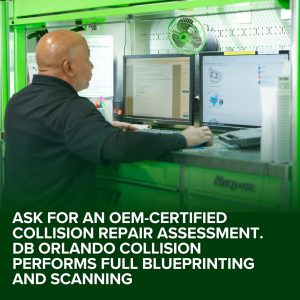
When in doubt, ask for an OEM-certified collision repair assessment. db Orlando Collision performs full blueprinting and scanning to classify the repair correctly.
Why Collision Repair Requires OEM Certification
Collision repair isn’t guesswork. It’s engineering compliance.
Automakers like:
- Honda / Acura
- Hyundai
- Subaru
- Mazda
- Lexus
- GM brands
- Nissan / Infiniti
- Kia
- FCA brands (Dodge, Jeep, RAM, Chrysler, Fiat)
…each publishes detailed structural and safety repair requirements.
OEM certification ensures a shop:
✔ Uses the exact tools and materials mandated
✔ Follows all factory sectioning and welding rules
✔ Performs mandatory safety scans
✔ Calibrates ADAS systems with OE equipment
✔ Documents all steps per OEM standards
✔ Passes ongoing factory audits
db Orlando Collision is OEM certified through Assured Performance/OEC and holds I-CAR Gold Classstatus with Platinum technicians, meaning we meet and exceed all of these standards.
Why Many Shops Offer “Auto Body Repair” Instead of Collision Repair
This section aligns with your preference for subtleDRP messaging.
Many shops advertise “auto body repair” because:
- They don’t have OEM certifications
- They lack structural repair equipment
- They can’t perform ADAS calibrations
- They rely on insurer DRP agreements
- They are required to keep costs low
- They avoid complex structural work
DB Orlando Collision is different.
We do notparticipate in DRPs because they often require:
- aftermarket or salvage parts
- skipping OEM-required steps
- lower labor times
- fast cycle times over safety
Instead, we follow:
- OEM-only repair procedures
- OEM parts policies
- Manufacturer scanning, measuring, and calibration requirements
This is the key difference between a cosmetic “auto body” shop and a true collision repair center that prioritizes safety over savings.
Why Choosing the Wrong Type of Shop Can Cost You More
Here are the most common risks when drivers choose an auto body shop for collision-level repairs:
1. Hidden Structural Damage Goes Undetected
Without blueprinting and measuring, structural issues remain invisible until the next accident, where your vehicle won’t protect you correctly.
2. ADAS Features Malfunction (Often Without Warning)
Automatic braking, lane assist, and blind spot detection rely on perfect alignment. Even a slight misplacement can cause:
- late airbag deployment
- misfires
- no deployment
3. Insurance Claims Become More Difficult
Low-quality repairs lead to:
- diminished value issues
- denied supplemental claims
- future repair complications
4. Repairs May Void OEM Warranties
Using non-OEM parts or incorrect procedures can violate warranty terms, especially for Hyundai, Kia, Honda, Subaru, and Lexus vehicles.
5. The Vehicle Becomes Dangerous in a Future Crash
This is the greatest risk. Incorrect welds, poor sectioning, or misaligned structures can transfer impact forces directly to occupants.
This is why db Orlando Collision was founded: to prevent unsafe repairs from happening to anyone else.
When “Just Cosmetic” Is Not Cosmetic at All in Auto Body Repair
A customer brings in a vehicle after a “simple” 8 mph bump from behind.
What we discover through blueprinting and scans:
- Rear body panel deformation
- Radar misalignment
- Cross-member stress
- Trunk floor buckle
- Active ADAS fault codes
To the customer and insurer, it looked like a bumper scratch.
To us, it was a full collision repairrequiring OEM engineering.
This happens every week.
Why db Orlando Collision Is the Safest Choice for Collision Repair in Orlando
You get:
✔ OEM-certified repairs
We follow manufacturer rules, not insurer guidelines.
✔ I-CAR Gold Class & Platinum techs
The highest level of industry training.
✔ Written lifetime warranty
On paint and workmanship.
✔ Advanced structural & ADAS equipment
Spanesi 106 JIG
ProSpot welders
Symach FixLine
Axalta digital color matching
✔ Two Orlando locations for convenience
East Orlando– Forsyth Rd
West Orlando– Edgewater Dr
✔ Rental coordination & towing support
Including same-day towing when the vehicle is unsafe.
✔ Transparency & customer advocacy
We explain every step in plain language and document everything.
When Do You Need Auto Body Repair Instead?
We also help customers identify when collision-level work is notnecessary.
Auto body repair is appropriate when:
- The damage is cosmetic
- There is no structural misalignment
- ADAS systems are unaffected
- Panels are properly aligned
- Paint is the primary issue
And if your vehicle only needs this level of repair? We’ll tell you, honestly.
Final Decision Guide: Auto Body vs. Collision Repair
Use this quick guide to determine which service you need:
Choose Auto Body Repair when…
- Damage is minor
- Panels aren’t bent
- No warning lights are present
- No sensors were hit
- No moving vehicle caused the damage
Choose Collision Repair when…
- The car was in an accident
- Structural areas were hit
- The wheels were struck, or the alignment feels off
- Airbags deployed
- Sensors are involved
- Gaps or lines look uneven
- Warning lights are on
- Insurance is involved
If you’re unsure? db Orlando Collision will diagnose it for you at OEM standards.
Conclusion: The Right Repair Protects Your Safety
Auto body repair may improve how your vehicle looks. Collision repair protects how your vehicle protects you.
Choosing the wrong type of shop can create hidden safety risks, but choosing an OEM-certified provider like db Orlando Collisionensures:
- proper repair documentation
- manufacturer-safe procedures
- accurate ADAS function
- restored crash performance
- warranty protection
- long-term value
Your safety is worth doing it the right way.
Ready for a Factory-Correct Repair Plan?
db Orlando Collision provides:
- OEM-certified collision repair
- Rental coordination
- Towing support
- Insurance advocacy
- Lifetime warranty on all paint & structural repairs
📍 Two Orlando Locations
• East: 2591 N Forsyth Rd, Orlando, FL 32807
• West: 6359 Edgewater Dr, Orlando, FL 32810
📞 East:(407) 467-5930
📞 West:(407) 436-6500
🔧 Factory Certified. Customer-focused.
FAQ About Auto Body Repair
1. What’s the difference between auto body and collision repair?
Auto body fixes cosmetic damage; collision repair restores safety systems, structure, and OEM performance after an accident.
2. Do I need OEM-certified repair after a crash?
Yes. OEM certification ensures your vehicle is rebuilt to factory safety standards with correct tools and procedures.
3. Can minor-looking damage still require collision repair?
Absolutely. Modern sensors and structures can be damaged even in low-speed impacts.