When your vehicle is damaged in a collision, one question matters more than any other: “Will my car be just as safe as it was before the accident?”
The fastest way to ensure that the answer is yesis to choose an OEM-certified auto body repair shop.
At db Orlando Collision, our OEM certifications guarantee your vehicle is repaired exactly the way the manufacturer requires, no shortcuts, no guesswork, and no insurer-driven compromises. That’s how we protect your safety, your investment, and your peace of mind.
OEM certification protects your vehicle’s safety by ensuring repairs follow your manufacturer’s exact repair procedures, tooling, materials, and safety system requirements.Certified shops are trained, inspected, and equipped by automakers to restore structural integrity, crash performance, and ADAS safety features back to pre-accident condition. db Orlando Collision is fully OEM-certified and follows all factory procedures on every repair.
Why OEM Certification Matters More Than Most Drivers Realize
Most people assume all body shops repair cars the same way. Unfortunately, that’s not true.
In today’s vehicles built with high-strength steels, aluminum, composites, advanced sensors, and multi-layered ADAS systems, the wrong repair can create hidden safety risksthat only reveal themselves in the next crash or emergency stop scenario.
That’s why OEM certificationexists. And it’s why db Orlando Collision made it a core part of our identity.
We proudly have OEM certifications for the following marks:
- Hyundai
- Honda / Acura
- Mazda
- Subaru
- Lexus
- Nissan / Infiniti
- GM
- Kia
- FCA brands (Dodge, Jeep, Chrysler, RAM, Fiat)
Every one of these automakers has unique specifications for scanning, welding, structural replacement, refinishing, calibrations, and parts selection. OEM certification ensures we do it their way, never the insurance company’s way.
What Happens If a Shop Isn’t OEM Certified?
A non-certified shop may:
- Use aftermarket or junkyard partsthat don’t perform like OEM.
- Skip mandated safety checks and calibrations.
- Use incorrect weldsthat weaken your vehicle’s structural cage.
- Fail to restore the crash energy management paths.
- Substitute cheaper procedures that the insurer prefers.
These shortcuts save money for the insurer, not you. And they can compromise:
- Airbag timing
- Crumple zones
- Sensor accuracy
- Side-impact protection
- Vehicle stability
- Battery and electrical safety
Repairing a modern vehicle without OEM procedures is guesswork. OEM certification eliminates that risk.
What Does OEM Certification Require?
Here’s a clear breakdown of what goes into it, and why it matters.
1. Factory Training
Technicians must complete brand-specific courses, hands-on training, and testing from the automaker itself. db Orlando Collision’s team holds:
- I-CAR Gold Class
- Platinum-certified technicians
- OEM program training across all certified brands
This ensures every repair follows current engineering standards.
2. Specialized Equipment
Modern cars require specific welders, structural jigs, measuring systems, and ADAS diagnostic tools.
db Orlando Collision invests in:
- Spanesi 106 JIGstructural systems
- ProSpot I4 & I5 OEM welders
- Symach FixLinerepair system
- Axalta digital color-matching
These aren’t optional in OEM-certified repairs; they’re required.
3. Facility Inspections & Audits
Automakers regularly inspect certified shops to verify:
- Equipment accuracy
- Technician credentials
- Repair documentation
- Quality standards
- Process compliance
Most shops never qualify because they can’t meet the requirements consistently.
4. Use of OEM Scan Tools & Procedures
OEM certification mandates:
- Pre-repair scans
- Post-repair scans
- OEM repair plan documentation
- Final safety checks
- Required calibrations
No guessing. No “looks good enough.” Everything must match the factory service manual.
How OEM Certification Protects You in a Real Collision
Below is a simple comparison that clearly shows the safety difference:
OEM Repair vs. Non-OEM Repair
| Safety Factor | OEM-Certified Repair | Non-Certified Repair |
| Structural Integrity | Repaired using manufacturer welds, materials & measurements | Often uses generic welds or incorrect steel, weakening the crash structure |
| Airbag Timing | Verified through scans & calibrations | May deploy late or not at all |
| ADAS Performance | Calibrated to OEM specs | Sensors may be misaligned or inactive |
| Parts Used | New OEM parts | Aftermarket or junkyard parts |
| Warranty Protection | Keeps OEM protections intact | Repairs may void warranties |
| Crash-Tested Safety | Restores factory crash paths | Unpredictable crash behavior |
The Real-World Difference: A Story That Changed Everything
db Orlando Collision was founded after owner Drew Bryantpersonally experienced an unsafe, improper repairon his own vehicle. That repair left his car dangerous to drive, and no one told him.
That moment became his mission: No more unsafe, insurer-driven shortcuts.
Today, that philosophy drives every repair plan, every customer interaction, and every OEM certification we hold.
How OEM Certification Reduces Common Customer Worries
Our customers show clear, recurring concerns across Orlando drivers:
- “I can’t afford to be without my car.”(Suzie)
- “I’ve been with my insurer forever, they said I should use their shop.”(Pete)
- “Just tell me what to do, what’s the right way?”(Doey)
- “It wasn’t my fault. Why should I pay?”(Paula)
Here’s how OEM certification directly speaks to those concerns:
- Safety for Your Family (Suzie “Soccer Mom”)
Suzie wants a repair that protects her kids. OEM certification ensures:
- Correct structural integrity
- Proper seat-belt & airbag system function
- Accurate ADAS (lane assist, automatic braking, blind spot monitoring)
- A vehicle she can trust on school runs and I-4 traffic
2. Proof & Transparency (Pete “Protect My Policy”)
Pete wants documentation he can trust.
OEM certification provides:
- OEM repair plans
- OEM procedure sheets
- Photos, scans & documentation
- Measurable proof that the insurer cannot dispute
This gives him confidence that he made the right choice.
3. Clear Guidance (Doey “Doing What I’m Told”)
Doey needs simple, clear direction.
OEM certification eliminates confusion:
- “This is the manufacturer-required way.”
- “Here’s what your vehicle needs and why.”
- “Here is documentation showing the exact steps.”
No guesswork. No pressure.
4. No Out-of-Pocket Surprises (Paula “Other Party Pay”)
Paula was hit by someone else and expects:
- No out-of-pocket cost
- OEM parts
- Proper repair
- Advocacy
Having OEM certification strengthens her claim by proving what the vehicle requires—not what the insurer prefers.
Why Modern Vehicles RequireOEM-Certified Repairs
Ten to fifteen years ago, many body shops could repair most vehicles without needing specialized OEM training. Today, that’s no longer possible. Modern vehicles are engineered with:
- High-strength steels and mixed metals
- Bonded panels instead of welded seams
- Radar, cameras, and LIDAR ADAS components
- Crash load paths are designed to collapse in exact sequences
- Battery management and sensitive electronics
Because every vehicle is engineered differently, each model has its own required repair blueprint, from weld lengths to adhesive types to calibration tolerances measured in millimeters.
Here’s why this matters:
1. Small Deviations = Big Safety Failures
A weld placed one inch off, a bumper reinforcement from a junkyard, or an uncalibrated sensor can all compromise how your vehicle protects you in a crash. OEM certification ensures repairs stay within exact safe limits.
2. ADAS Systems Cannot Be “Eyeballed”
Lane assist, automatic braking, blind spot monitors, and adaptive cruise control, none of these work without precise diagnostics and calibrations. Certified shops follow OEM calibration requirements that generic shops may skip.
3. Structural Materials Behave Differently
Ultra-high-strength steel cannot be heated, repaired, or welded like traditional steel. Aluminum cannot be repaired in the same room as steel without contamination. OEM training teaches technicians the correct rules for each material.
4. Repairs Affect Future Crash Performance
Every vehicle is designed to crush, fold, or stay rigid in predetermined ways. Improper repairs change how energy moves through the vehicle and can put the driver at risk. OEM certification protects those engineered pathways.
Why db Orlando Collision’s OEM Certification Is Different
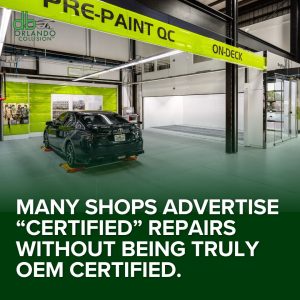
Many shops advertise “certified” repairs without being truly OEM certified. db Orlando Collision stands apart because:
✔ We are NOT a DRP shop
We refuse insurer contracts that require cost-cutting. Our only obligation is to your safety.
✔ We follow OEM procedures on every repair
Not approximate. Not optional. Required.
✔ We invest heavily in proper equipment & training
Spanesi, Symach, Axalta, and ProSpot, chosen because OEMs require them.
✔ We provide a Written Lifetime Warranty
On all structural, paint, and workmanship repairs. Learn more in our FAQs.
✔ We help with rentals, towing & insurance advocacy
Including same-day towing if your vehicle isn’t safe to drive.
✔ We operate two state-of-the-art facilities in Orlando
- East Orlando:2591 N Forsyth Rd
- West Orlando:6359 Edgewater Dr
How OEM Certification Protects You Financially
1. Preserves Your Vehicle’s Value
OEM parts + OEM procedures = Higher resale value and stronger diminished value claims.
2. Prevents Long-Term Mechanical & Electrical Issues
Improper repairs cause:
- Water leaks
- Premature rust
- ADAS failures
- Electrical shorts
- Alignment issues
OEM-certified repairs prevent these hidden, costly problems.
3. Protects Lease & Warranty Requirements
If your car is leased, or still under warranty, using non-OEM parts may violate:
- Lease return conditions
- Manufacturer warranty rules
OEM certification keeps you compliant.
Insurance Companies vs. OEM Certification: What You Need to Know
Many insurers recommend DRP shops because those shops agree to:
- Lower labor rates
- Aftermarket parts
- Fewer OEM procedures
- Negotiated shortcuts
db Orlando Collision will neverprioritize an insurance company’s contract over your safety.
We work with all insurers, but we do notwork forthem. We work for you.
Why You Can Trust db Orlando Collision With Your Vehicle
Our entire shop was built around one belief: A repaired car must be just as safe, if not safer, than it was before the accident. And OEM certification is the foundation of that promise.
Every repair includes:
- Full blueprinting
- OEM repair plan documentation
- Pre-scan, post-scan & calibrations
- ADAS verification
- Structural measuring
- Color-matched refinishing
- Final quality control with timestamped steps
We don’t cut corners. We don’t compromise. We don’t apologize for doing things the right way.
Ready to Protect Your Vehicle’s Safety?
If you want your vehicle repaired to factory standards, with OEM documentation, and lifetime-backed workmanship, contact db Orlando Collision.
We’ll handle:
- Insurance communication
- Rental car coordination
- Repair planning
- OEM parts ordering
- Towing (if needed)
All with complete transparencyand customer-first care.
📍 Two Orlando Locations:
- East Orlando:2591 N Forsyth Rd
- West Orlando:6359 Edgewater Dr
📞 Call Us:
- East: (407) 467-5930
- West: (407) 436-6500
🔧 Factory Certified. Customer Focused.
FAQ About OEM-Certificated Body Shops
1. What is an OEM-certified auto body repair shop?
A shop trained and approved by your automaker to repair your vehicle using factory methods, tools, and parts.
2. Does OEM certification make my repair safer?
Yes. It ensures your car is restored to its original crash performance and safety system accuracy.
3. Will my insurance cover OEM-certified repairs?
Yes. You choose the shop. We advocate for OEM procedures and help handle insurer objections.